


Inside Team Building in Japanese Workplaces
Japanese companies often invest in organized team building activities as a way to maintain harmony and strong group cohesion in the workplace. In Japan’s corporate culture, working together as a harmonious unit (wa, 和) is highly valued.
Many companies organize social events and outings for employees, from after work gatherings to weekend retreats, to help colleagues bond outside the usual office setting. In this post, we explore how these team building events, retreats, and activities strengthen workplace relationships in Japan.
Why Team Cohesion Matters in Japanese Work Culture
The workplace in Japan functions as a collective unit where the success of the group takes precedence over individual recognition. Collaboration is often influenced by the cultural concept of wa (和), which represents the Japanese pursuit of harmony and peace within a social group and the importance of maintaining positive interpersonal relationships.
In a corporate setting, this means avoiding direct confrontation and ensuring that every team member feels included; the success of a project is typically seen as a shared responsibility rather than the result of individual achievement alone.
Because teamwork is so central, many companies actively invest in activities that strengthen interpersonal connections among employees. Organized events, retreats, and group activities provide opportunities for colleagues to interact in more informal settings, helping build trust and familiarity across departments and seniority levels.
These interactions can make everyday work easier, and when employees feel comfortable communicating with one another, coordination becomes easier, misunderstandings are reduced, and teams are better able to collaborate effectively on projects.

Company Gatherings and Social Events
Building professional unity in Japan often begins outside the office; bonds frequently form over shared meals and drinks, as these moments lower social barriers and help colleagues build strong personal connections. While formal structures define the workday, informal gatherings often provide the foundation for stronger team cohesion.
Drinking parties, or nomikai, are one of the most common ways colleagues interact outside the workplace. During these events, hierarchies tend to soften, making it easier for employees to speak more openly. Many people use these gatherings to share opinions or concerns that they might hesitate to express in the office.
Another classic example is bonenkai (忘年会), the yearend party that most companies hold in December. Colleagues gather at a restaurant or izakaya to eat, drink, and mark the end of the year together. Many offices also organize a shinnenkai (新年会) in January, a New Year gathering meant to welcome the coming year with good cheer and team spirit.
Other common events include welcome parties (kangeikai, 歓迎会) for new employees, farewell parties (sōbetsukai, 送別会) for colleagues who are leaving, company anniversary celebrations, and various seasonal gatherings. In spring, some companies organize hanami (花見), or cherry blossom viewing outings, where employees gather in parks to enjoy the spring weather, share food, and spend time chatting under the blossoms.
During an enkai (宴会, banquet-style gatherings), usual workplace formalities tend to relax. Coworkers share meals and drinks in a more casual setting, allowing people to unwind and talk more freely than they might during the workday. All of these social events aim to encourage open communication, with the hope that it later translates into better communication and relationships at work.

Company Retreats and Training Trips
In addition to activities within the office, many Japanese companies organize offsite retreats or training trips designed to strengthen teamwork and communication. Often referred to as team building retreats or incorporated into company trips (shain ryokō, 社員旅行); in this context, team building refers to creating an organization where members unite around a common objective and cooperate effectively as a group, helping reduce the vertical barriers that often exist in office hierarchies.
These retreats usually last one or several days and combine professional development with recreational activities. Companies may organize workshops, strategy discussions, or training exercises alongside shared meals and social activities.
Many programs include collaborative challenges designed to simulate real teamwork situations. Employees may participate in group problem solving exercises, outdoor challenges, or strategy workshops that require planning, coordination, and communication.
Some retreats also include experiential activities such as cooking competitions, outdoor navigation games, sports tournaments, or interactive team games. These activities create a relaxed environment where employees can interact more freely and collaborate with colleagues they may not normally work with in the office, offering opportunities to learn from each other and observe how teams function under different conditions.
By sharing challenges and achievements during the trip, employees often develop a stronger sense of belonging and a clearer understanding of their roles within the team and the company, contributing to more effective collaboration in everyday work.

Volunteer and Community Activities
Another approach to team building in Japan is through corporate volunteering and community service. Many companies encourage employees to volunteer together for worthwhile causes, seeing it as an opportunity for team bonding and social involvement.
Examples of corporate volunteering include environmental cleanup projects, such as beach or park restoration efforts, disaster recovery volunteering in areas affected by natural disasters, and participation in community events or charity projects organized with local organizations.
Some large companies even have formal programs to support this; for instance, Itochu Corporation allows employees to take a few days of volunteer leave each year to participate in community activities, along with different volunteer programs employees can join.
These activities allow team members to bond while contributing to society, strengthening both their team spirit and their connection to the company’s mission. At the same time, volunteering as a group reinforces a company’s values and commitment to corporate social responsibility, which can be motivating for employees.

Sports Days and Physical Activities
Some Japanese companies organize sports events similar to school sports festivals (運動会, undōkai), creating opportunities for employees to participate in physical activities together. These events are sometimes held at local sports facilities, parks, or company training centers, and employees are usually mixed into teams that cut across departments and seniority levels, so people who might not interact much at work get to play on the same side.
Typical activities include relay races, tug-of-war, dodgeball matches, team obstacle courses, and company sports tournaments such as soccer, volleyball, or baseball. These competitions are usually designed to be fun and inclusive so that employees of different ages and physical abilities can participate.
These physical team building activities have multiple benefits: not only do they energize communication and improve teamwork, but they also contribute to employees’ health and wellbeing.
Sports days also promote friendly competition while softening the usual workplace hierarchy. When managers and junior employees play on the same team, the atmosphere often becomes more relaxed, making it easier for colleagues to interact and communicate more openly.
Organized Team Building Programs
In addition to internal events or retreats, many companies in Japan collaborate with professional team building organizations that design structured activities to improve teamwork and communication. These programs are often facilitated by external specialists who create interactive challenges tailored to corporate groups, strengthening collaboration and engagement among employees.
Puzzle and Escape Challenges: Typical programs include escape room style challenges, scavenger hunts, or other problem solving activities where teams complete tasks together under time constraints. These exercises encourage participants to share ideas, coordinate strategies, and rely on each other’s strengths.
Creative Workshops (e.g. Cooking or Crafts): Companies may also choose creative or cultural workshops such as cooking classes, craft activities, or traditional experiences like tea ceremonies or drumming sessions.
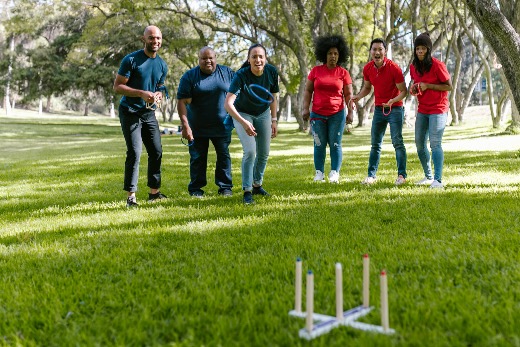
Physical and Outdoor Challenges: Large scale collaborative games are another common format. Teams work through mental, physical, or creative challenges that require planning, communication, and coordination. Programs may include outdoor obstacle courses, trust exercises, or sports games that encourage teamwork while strengthening skills such as leadership, cooperation, and communication.
The Growing Team Building Industry
Companies such as Catalyst Japan show how established the corporate team building sector has become. Organizations in this field organize structured activities for businesses across Japan, ranging from small workshops to large events with hundreds of participants.
Cities and convention organizations also support these programs as part of corporate events and incentive travel. For example, initiatives promoted by groups such as the Sapporo Convention Bureau and the Japan Convention Bureau include city wide challenges, cultural workshops, and outdoor problem-solving activities.
More broadly, the team building services industry has expanded quickly across the Asia Pacific region as companies invest more in employee development and workplace collaboration. The region represents nearly 30% of the global team building services market and could reach around USD 10.1 billion by 2034, driven by digital transformation, human resources investment, and growing interest in employee wellbeing and productivity.

What the Data Says About Team Building Outcomes
Research suggests that team building activities can improve workplace relationships, with the strongest effects appearing in areas such as communication and trust. A 2025 Japanese study by Senshu University examined a two-day team building program; after the program, participants showed a statistically significant increase in their belief in the value of working with others (協同効用) and a decrease in preference for working alone (個人志向), indicating that the program helped participants become more open to collaboration.
Research identifies several practical outcomes companies often observe after team building initiatives:
- increased communication between team members
- stronger trust and mutual understanding
- clearer roles and responsibilities within teams
- improved collaboration in problem solving tasks
- expanded relationship networks inside teams
Researchers also emphasize that these programs are most effective when companies define clear goals such as trust building, role clarity, or process improvement rather than treating them as one-time recreational activities.
Workplace data from Japan also helps explain why these outcomes matter. According to Gensler’s Global Workplace Survey 2025, Japanese workers reported spending the most time working alone during a typical week among the countries surveyed, and only 42% said their workplace offers a great experience, compared with a global average of 72%. Employees who reported a better workplace experience also reported stronger collaboration and social interaction, suggesting that teamwork does not develop automatically and requires supportive conditions from organizations.
Changing Approaches to Team Building
The way companies approach team building is also evolving; rather than relying only on traditional in person formats, some programs are now designed for both on site and online participation to accommodate hybrid and remote teams. Research in Japan also points to a growing preference for flexibility, with employees benefiting from a wider variety of work styles and collaboration formats.
At the same time, workplace changes such as remote work, more fragmented departments, and an increase in mid-career hires have made team cohesion harder to maintain. As a result, companies are exploring formats that rebuild trust and shared understanding without relying only on traditional after work gatherings.
Participation formats are also becoming more flexible, with some companies now organizing shorter day trip programs instead of overnight retreats, and participation increasingly voluntary rather than mandatory.
This shift is also reflected in a 2025 survey by Hot Pepper Gourmet Research, which found that the proportion of drinking parties dropped from about 75% in 2017 to around 60% in 2025, while expectations for these events as communication opportunities also declined. Companies are therefore increasingly expected to design activities that feel purposeful and voluntary rather than simply traditional obligations.

Building Workplace Cohesion

Team building events and activities in Japanese companies all serve to strengthen the foundation of workplace relationships. They may take different forms, but the underlying goal is the same: to create a cooperative and harmonious environment where colleagues trust each other and work together effectively.
These traditions of after-hours socializing and group activities have supported collaboration and team cohesion in Japan for generations. By bringing people together outside the daily routine, they break down barriers and allow coworkers to connect as human beings.
🤝 Make Connections in Japan
One of the most valuable parts of doing an internship in Japan is the chance to build relationships with people from different teams, departments, and backgrounds. If you’d like to experience this environment yourself, join the program or reach out to us to explore internship opportunities in Japan!


