
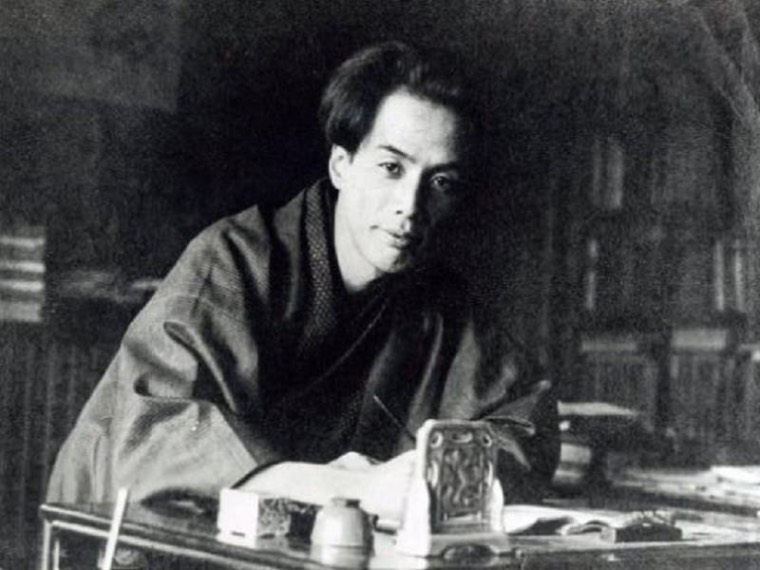

Ryūnosuke Akutagawa: Life, Works, and Legacy
Ryūnosuke Akutagawa was one of the most influential writers in modern Japanese literature. Best known for shaping modern Japanese short fiction, his work helped define how stories could explore perspective, morality, and human psychology within a concise form. Today, his writings continue to be widely read, adapted, and studied both in Japan and internationally.
The Formative Years: Family and Education
Born in 1892 in Tokyo as Ryūnosuke Niihara, he was adopted and raised by his maternal uncle, later taking the Akutagawa surname after his mother developed a serious mental illness that worsened shortly after his birth; an experience that had a lasting impact on him.
His adoptive family came from a former samurai lineage connected to the Tokugawa period and valued the arts and traditional culture. This environment exposed him early to classical literature, and from a young age he showed a strong interest in classical Chinese texts, Japanese literature, and Western authors, which later contributed to his style and broad vocabulary.
Academic Background and Early Career
Akutagawa showed strong academic ability and studied English literature at Tokyo Imperial University (today the University of Tokyo), where he was exposed to both Western and Japanese literary traditions and where he began writing seriously and engaging with literary circles.
He was influenced by Western writers such as Edgar Allan Poe and Anatole France, whose exploration of the darker aspects of human nature informed his work. By integrating these elements into Japanese settings, he developed a distinctive approach that set his work apart in the literary community.
His breakthrough came in 1916 with The Nose, which received praise from Natsume Sōseki and helped establish his reputation. After graduating, he briefly worked as an English teacher before focusing on writing full-time. In addition to prose, Akutagawa also wrote haiku, producing around one thousand poems over his lifetime.

Final Years
Despite his early success, Akutagawa struggled with mental health throughout his life, developing a growing fear of having inherited his mother’s illness. His later years were marked by increasing psychological and physical strain. Akutagawa died in July 1927 at the age of 35 by suicide, after taking an overdose of a barbiturate.
His death followed a period of worsening mental health, marked by visual hallucinations, chronic anxiety and insomnia. In a note written shortly before, he described his state as a “vague sense of anxiety about [his] future,” a phrase often associated with the tone of his final works. His remains are buried at Jigan-ji Temple in Tokyo.

The Father of the Japanese Short Story
Akutagawa is widely regarded as the “father of the Japanese short story,” not because he invented the form, but because he established it as a central genre in modern Japan. His work focused almost entirely on short fiction; he wrote over a hundred short stories and no full-length novels, showing how the format can handle complex themes and psychological depth. He believed the short form allowed for a sharper focus on human flaws and social contradictions.
Writing in the Taishō Era
Akutagawa’s work flourished during the Taishō period (1912–1926), a time of major literary change driven by modernization and exposure to Western movements. Writers moved away from traditional storytelling and explored new techniques and perspectives.
Akutagawa’s work stands out for combining traditional materials with modern narrative structures, placing him among the key figures of Taishō modernism. He also captured the tension between traditional values and the rapid modernization happening around him, making his stories a perfect case study for the social shifts of that decade.
Use of Historical Settings
A defining feature of his writing is the frequent use of historical settings, especially from the Heian and Edo periods. Many of his stories draw on older texts, including collections of anecdotes and religious tales such as the Konjaku Monogatari (Tales of Times Now Past, 794–1185). But rather than aiming for only a historical reconstruction, they served as a framework to explore timeless questions about human behavior and ethics, and by applying modern psychological perspectives to these narratives, he made them feel relevant to contemporary readers.

Style and Narrative Approach
Akutagawa’s writing is characterized by a precise and structured prose style, with a strong focus on psychological realism and narrative construction. Characters are often portrayed through their internal conflicts, motivations, and perceptions rather than external action alone. His stories frequently avoid clear resolutions, instead presenting situations that remain open to interpretation and require readers to draw their own conclusions.
Across his work, several themes appear consistently:
- Human psychology, particularly how individuals perceive reality and justify their actions
- Moral ambiguity, placing characters in situations without clear right or wrong outcomes
- Historical fantasy and the grotesque, mixing realistic settings with disturbing or exaggerated elements
- Irony and satire, often used to critique social norms, religion, or human behavior, as seen in The Nose or Kappa
Distance from the Shishōsetsu Tradition
During Akutagawa’s time, one of the dominant literary forms in Japan was the shishōsetsu (I-novel), based on direct personal experience and confessional writing, where the author and protagonist largely overlap. Akutagawa kept his distance from this approach, maintaining artistic control and separation from his subject matter.
Over time, however, he attracted criticism for relying too heavily on external sources and historical material, and for lacking originality.cIn his later years, he experimented with more introspective forms, incorporating elements closer to the shishōsetsu.
This period was marked by trial and error; despite these attempts, he never fully adopted the genre, and the contrast between his more successful and less effective works became more evident. Part of this hesitation can be linked to the nature of the I-novel itself, which requires exposing the author’s personal life and limits objective distance, something difficult for a troubled writer like Akutagawa.
In his final works, such as The Life of a Stupid Man and Spinning Gears (both from 1927), this distance begins to collapse. These texts show how engaging more directly with his own thoughts did not resolve this tension but instead intensified the anxiety, isolation, and instability that ultimately led him to take his own life.

Key Works and What They Show
Rashōmon (1915)
Rashōmon (羅生門) is set during a period of social decline, marked by famine, natural disasters, and weakened political authority. The story takes place under the Rashōmon gate, the former southern entrance to Kyoto (then called Heian-kyō), which had fallen into disrepair and become associated with abandonment and death.
The narrative centers on a character facing uncertainty and survival, where social structures no longer provide stability. An encounter with another individual acting out of necessity becomes the turning point, focusing on moral compromise under pressure. Rather than offering clear judgment, the story shows how ethical boundaries can change depending on circumstances.
The Rashōmon gate also reflects the physical and social decay of the time, while also functioning as a transitional space between life and death, order and disorder, and opposing moral positions. The story leaves an unresolved question: to what extent can immoral actions be excused by life circumstances, and where is the limit of responsibility?

The Nose (1916)
The Nose (Hana, 鼻) is one of Akutagawa’s earliest successful works and shows a different side of his writing through its satirical tone and use of grotesque elements. The story centers on a Buddhist monk preoccupied with his unusually large nose and how others perceive him.
The grotesque aspect lies not only in the feature itself, but in the monk’s obsession with correcting it through uncomfortable and absurd treatments. This places the focus on how perception defines identity, suggesting that what appears “monstrous” is shaped by self-consciousness and social judgment.
At the same time, the story functions as social satire; others initially mock the monk, but after his nose is shortened, they laugh at him even more openly, revealing how superficial social approval can be and how self-perception can differ from how others see us. Through this mix of humor and discomfort, The Nose shows Akutagawa’s ability to use a simple premise to explore themes of vanity, egotism, insecurity, and social expectations.

Hell Screen (1918)
Hell Screen (Jigokuhen, 地獄変) explores the relationship between art and reality through the figure of Yoshihide, a painter commissioned to create a folding screen depicting scenes from hell. The story examines what an artist is willing to do to achieve artistic perfection.
The artist is portrayed as completely committed to accuracy and authenticity in his work, to the point where artistic goals begin to take priority over ethical judgment. This escalation raises a central question: whether there is a limit to artistic pursuit, and what happens when the desire to create something “true” leads to morally questionable choices.
The story also explores the relationship between representation and reality, suggesting that the effort to depict something faithfully can blur the boundary between depicting suffering and enabling it. As a result, the artwork becomes inseparable from the act that made it possible, linking creation with destruction.

In a Grove (1922)
In a Grove (Yabu no Naka, 藪の中) is one of Akutagawa’s most studied stories and a clear example of his approach to narrative structure and perspective. It presents the death of a samurai through multiple testimonies, each offering a different version of the same event, with contradictions that make it impossible to determine what actually happened.
The structure emphasizes the absence of a single, objective truth. Each account reflects the speaker’s motives, biases, and self-image, showing how individuals interpret events in ways that justify their actions. The story focuses less on the crime itself and more on the instability of truth and the subjectivity of human perception.
It also raises questions of moral responsibility, as each character minimizes their own guilt or redefines their role. By presenting conflicting accounts without resolution, In a Grove leaves interpretation to the reader, making it a clear example of Akutagawa’s use of open-ended storytelling.

The Life of a Stupid Man (1927)
Published posthumously, The Life of a Stupid Man (Aru ahō no isshō, 或阿呆の一生) is one of Akutagawa’s final works and differs significantly from his earlier stories. Instead of a continuous narrative, it is composed of short, fragmented sections presenting moments, reflections, and impressions from the life of an unnamed character.
The text functions as a retrospective overview; its structure reflects the instability of the narrator’s thoughts, moving between observations, memories, and detached commentary without a clear progression. Because of when it was written, the work is often read as closely connected to Akutagawa’s own life and state of mind in his final years.
While it is not presented as a direct autobiography, it reflects themes of fatigue, detachment, and self-examination. It traces his mental decline and sense of isolation, offering a direct view of his final years and his decision to end his life.

The Lasting Legacy and Global Impact
Akutagawa left a lasting mark on Japanese culture that remains evident today; his short stories are recognized for their psychological depth and structure, and this influence is reflected in awards that bear his name and in adaptations that brought his work to a global audience.
The Prestige of the Akutagawa Prize
Akutagawa’s influence extends beyond his own writing, most visibly through the Akutagawa Prize, established in 1935 by writer Kikuchi Kan. Awarded twice a year, it focuses on new or emerging writers of literary fiction and remains one of the most important entry points into the Japanese literary world. Over time, it has helped launch the careers of many authors and continues to shape contemporary literature.
Global Adaptations in Film and Theater
His work has had a lasting impact across different media. In film, his influence is closely linked to Rashōmon, adapted by Akira Kurosawa in 1950. The film combines elements from both Rashōmon and In a Grove, using the latter’s multiple-perspective structure as its narrative foundation.
Beyond literature and film, Akutagawa continues to appear in modern media; his works are referenced in manga and anime such as Bungo Stray Dogs, where historical authors are reinterpreted as fictional characters. His stories have also inspired adaptations in other arts: Ukrainian composer Victoria Poleva created the ballet Gagaku (1994), based on Hell Screen, while writer Yukio Mishima adapted the same story into a Kabuki play in 1953.

His Influence on Contemporary Literature
Modern authors continue to revisit the narrative structures Akutagawa developed. His focus on the subjective nature of truth and the darker aspects of the human psyche remains relevant today. This influence can be seen in writers such as Osamu Dazai and Haruki Murakami, who have engaged with similar themes and narrative approaches. His works are also widely taught in academic settings and translated into many languages, contributing to his continued presence in both Japanese and international literary contexts.
A Modern Classic

Akutagawa’s work shows how literature can bridge past and present, and it remains relevant by addressing themes of human behavior that continue to resonate today. At the same time, his stories are short and accessible, making them easy to approach even for first-time readers of Japanese literature. For this reason, his writing is often considered a strong starting point for those looking to explore modern Japanese fiction.
✍️️ Go Beyond the Page
Akutagawa’s work offers insight into Japanese literature, but understanding its context often comes from experiencing the country itself; an internship in Japan gives you the perfect opportunity to do that. Get in touch with us or join the program to learn more!


