


Valentine’s Day in Japan: Origins and Changing Customs
Valentine’s Day in Japan is structured around customs that differ significantly from those in Western countries. What began as a strategy driven by marketing in the postwar period developed into a system of gift-giving shaped by gendered expectations, social obligation, and workplace culture. Chocolate, rather than cards or flowers, became central to the holiday, and the act of giving often carried meanings not tied solely to romance.
Over time, these practices expanded beyond romantic relationships to include colleagues, friends, and even self-gifting. Looking at how Valentine’s Day in Japan has evolved offers a window into how commercial influence and social norms affect the way celebrations take form.
How Valentine’s Day Started in Japan
Valentine’s Day as a holiday was virtually unknown in Japan until the mid-20th century, and like Christmas in Japan, its introduction was entirely driven by marketing. An early attempt occurred in 1936 when a Kobe confectioner, Morozoff, placed a newspaper ad encouraging people to give chocolates on Valentine’s Day to increase sales. That ad failed to make noise, and the custom didn’t catch on with the Japanese public at that time.
It wasn’t until the postwar economic boom that the tradition truly became established; in 1956, the Fujiya candy company began selling sweets shaped as a heart for Valentine’s Day, and by 1958 the Mary Chocolate Company promoted Valentine chocolate sales at a department store in Tokyo. These efforts are regarded as the real beginning of Japan’s Valentine’s Day market activity.
Throughout the 1960s, other sweets manufacturers and department stores joined in, seizing Valentine’s Day as a marketing opportunity. Major chocolate brands like Morinaga ran Valentine’s ads in women’s magazines, and specialty chocolatiers sold themed products. Crucially, these campaigns all framed Valentine’s Day as a time for women to give chocolate to men.
By the early 1970s, the idea had taken hold: giving chocolates on February 14 had become an established practice in Japan. The role of confectionery companies and department stores was central; they not only popularized the holiday but also essentially defined its norms, including the notion that women should be the givers of gifts on this day.
Various anecdotes attempt to explain why the custom became women-to-men, but it ultimately boils down to a deliberate marketing strategy. By targeting female consumers as the gift-givers, companies unlocked a new market, and Valentine’s Day in Japan found its base.

The Core Tradition: All About Chocolate
One striking aspect of Japan’s Valentine’s Day is its strong focus on chocolate, and unlike Valentine celebrations in many other countries, which may involve cards, flowers, or a range of gifts, Japan’s tradition centers almost exclusively on chocolate. Over time, repeated marketing reinforced this idea, turning chocolate from one option into the expected gift, with alternatives remaining relatively uncommon.
Shelves are filled with chocolates ranging from inexpensive candies to gourmet truffles, and women are, or due to recent changes, were expected to purchase (or sometimes hand-make) an array of chocolates for the occasion.
The tradition is also largely one-sided on this date: typically, only women give presents on February 14, and men do not reciprocate until one month later (on “White Day” in March), a difference from Western norms, where it’s common for couples to exchange gifts.
As to why only chocolate, the simple answer is that Japanese confectioners essentially invented the holiday in its local form. Chocolate companies heavily promoted Valentine’s Day, so giving chocolate became perceived as the proper way to celebrate.
By the late 20th century, Valentine’s Day had turned into the busiest season for Japan’s chocolate makers, a multibillion-yen business concentrated in a few weeks each year, during which many department stores organize Valentine fairs with a wide range of chocolate brands and special edition items to attract shoppers.
Although commercial influence played a major role in establishing these practices, they have since taken on social weight, and over time, a strong expectation emerged that women “should” give out chocolates on Valentine’s Day not only to romantic interests but to others around them as well.
Many women felt it was almost a duty to distribute chocolates to friends, colleagues, and family as a sign of appreciation, and not giving chocolates to someone could risk offense. What started as a commercial initiative eventually turned into a social obligation in many contexts.

Types of Valentine’s Chocolate in Japan
Over time, Japanese society developed specific categories of Valentine’s chocolates to distinguish different intentions behind each gift. Not all chocolates are equal; who you give them to and why matters.
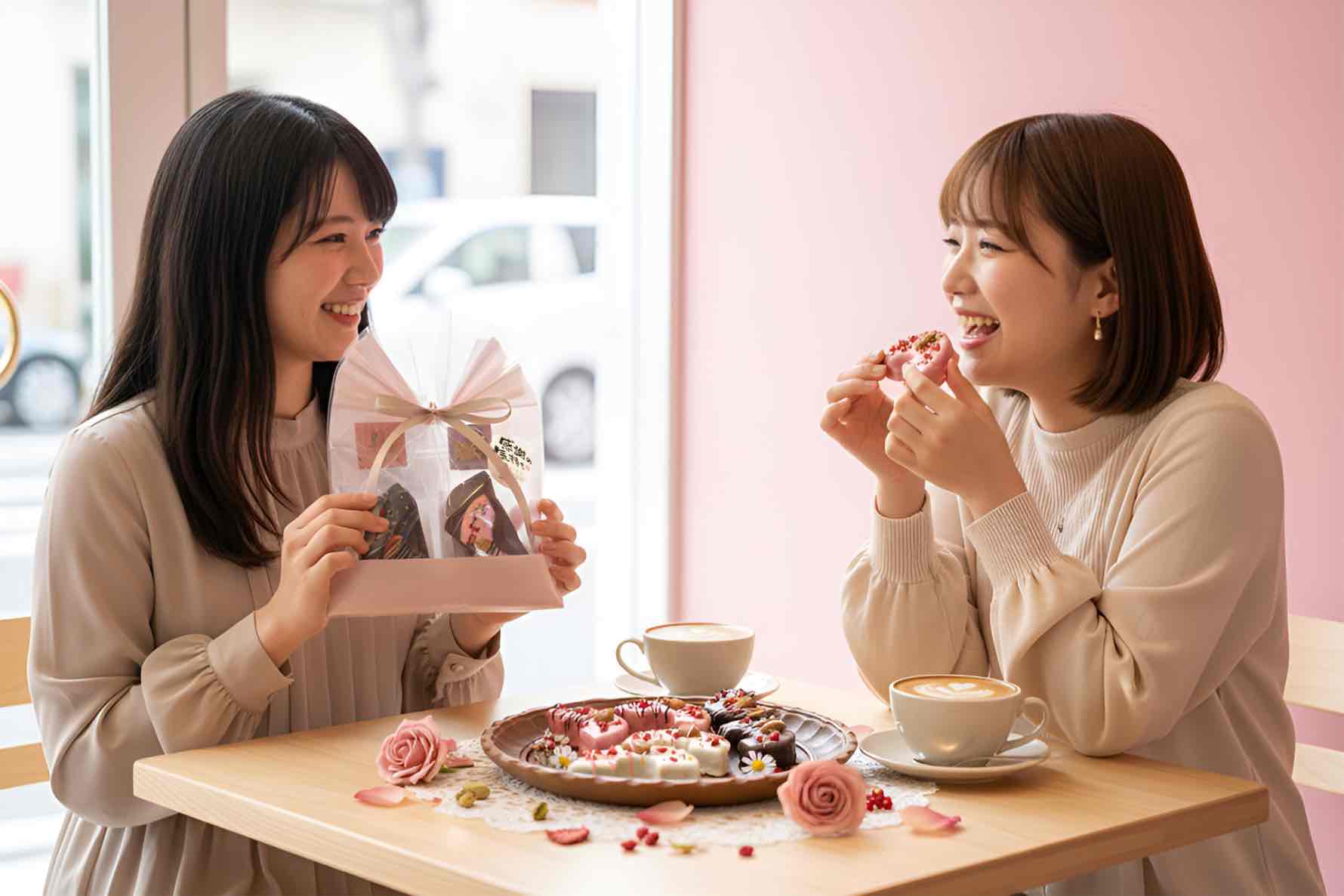
Honmei-choco (本命チョコ), or “true love chocolate,” is given with romantic intent, typically to a partner or someone a person has feelings for. It often involves more thought and effort, such as handmade chocolates or premium brands, and a more curated presentation. It's commonly used by teenagers and young adults to express affection.
Giri-choco (義理チョコ), meaning “obligation chocolate,” is traditionally given in workplaces or formal settings to colleagues or supervisors. It reflects social duty (giri) rather than romance and is usually inexpensive and standardized. While still present, its role has been increasingly questioned and has declined in recent years.
Tomo-choco (友チョコ), or “friend chocolate,” emerged as an alternative to the traditional system. Popular among younger people, it emphasizes mutual exchange and friendship, often through shared activities like baking or decorating treats together.
Jibun-choco (自分チョコ), "self-chocolate," refers to buying chocolate for oneself. This trend has grown significantly, with a 2025 survey showing that over 60% of women planning to buy Valentine’s chocolate intended to do so for themselves, compared to about one third planning to give any to coworkers. Department stores have responded by expanding selections of high-end chocolates aimed at self-buyers, showing that it is more acceptable now to simply enjoy the holiday solo (and perhaps as a subtle rebellion against the obligation to always give to others).

White Day in Japan: Returning the Favor
One month later, on March 14, comes the companion holiday: White Day. On this day, men who received chocolates on Valentine’s Day are expected to return the favor by giving gifts to the women who gave them to them. The concept was introduced to “complete” the Valentine’s tradition in Japan.
An early version appeared in 1977, when a Fukuoka sweets company promoted marshmallows for March 14 under the name “Marshmallow Day.” But what is now known as White Day was first celebrated in 1978, and like Valentine’s Day, it emerged from confectionery industry marketing.
Realizing that Valentine’s Day had become a one-way affair (and a lucrative one for chocolate sellers), the National Confectionery Industry Association promoted March 14 as an “Answer Day” to encourage men to give gifts in return. Within a year, the idea evolved into White Day, named presumably for the color of sugar or marshmallows.
Originally, white-colored confections like marshmallows, white chocolate, or candy were common gifts. Over time, the range expanded, and today men may give cookies, cakes, or even non-sweets such as jewelry, accessories, or flowers.
A well-known informal rule associated with White Day is sanbai gaeshi (三倍返し), meaning “triple the return,” which suggests that the return gift should be two to three times the value of the Valentine gift. From the industry’s perspective, of course, this was great for business; from a social perspective, it further codified the gender roles embedded in the holiday.
The Valentine’s Day and White Day system aligned with Japan’s emphasis on returning favors (okaeshi), but by formalizing this exchange, it fixed a pattern of women as givers and men as returners. For a long time, this arrangement was accepted as standard, and only in recent years have people begun questioning whether this gendered exchange is still necessary or fair.

Valentine’s Day in the Workplace
One of the most distinctive (and often controversial) aspects of Japan’s Valentine customs has been the workplace gifting tradition. In many offices, it became common for female employees to give chocolates to male colleagues and supervisors on Valentine’s Day, (giri-choco, “obligation chocolate”). This custom emerged in the postwar corporate environment and was especially prevalent through the 1980s and 1990s, when workplaces often had clear gender divisions and women frequently occupied support roles.
Giri-choco was framed as a polite acknowledgment of everyday working relationships, but it was also reinforced by peer pressure. If other women in a department were giving chocolates, opting out risked appearing rude. Over time, many offices developed an unspoken expectation that women would give chocolates on February 14, with men reciprocating collectively on White Day.
The practice often involved careful social calculations, taking hierarchy and relationships into account, and for many women it turned Valentine’s Day into an annual obligation rather than a voluntary gesture. Many described it as emotional labor: time, money, and mental effort spent maintaining workplace harmony without direct benefit. As women’s workforce participation increased and gender expectations evolved, surveys and media commentary from the 2000s onward reflected growing discomfort with the custom.
How Workplace Valentine’s Day Is Changing
In recent years, compulsory giri-choco has faced sustained criticism. By the late 2010s, surveys showed that many employees, both men and women, were uncomfortable with the practice, with around 40% in one poll even labeling it a form of workplace power harassment.
As a result, the custom has sharply declined: a 2025 survey found that only 12.5% of respondents planned to give Valentine’s gifts to colleagues, down from 23.7% in 2020 and around 35% in 2019. Public messaging has also played a role: in 2018, the Japanese branch of Godiva ran a full-page newspaper ad urging people to stop obligation gifting when it is done under pressure.
At the same time, who buys chocolate is starting to change as well: a recent Studyplus survey found that about 23% of male middle and high school students planned to give chocolate to friends or someone they like, a trend known as gyaku-choco (“reverse chocolate”).
In response, some companies have introduced bans or discouragements around Valentine gifting, while others promote more neutral alternatives. What was once treated as a workplace expectation has increasingly become a personal choice, reflecting wider changes in attitudes toward gender roles and workplace norms.

Valentine’s Day in Japan Today
Valentine’s Day in Japan has not disappeared, but its meaning and practices have changed noticeably over the past two decades. While chocolate remains the holiday’s central symbol, the way it is given and the expectations attached to it are far less rigid than they once were.
Some elements remain consistent; chocolate companies and department stores still treat February as a major sales period, releasing seasonal collections and limited editions, and honmei-choco continues to serve as a way to express romantic interest.
The most significant change has been the decline of obligatory gestures, particularly mass workplace chocolate giving. As discussed earlier, the coercive side of the tradition is gradually being left behind. Today, Valentine’s Day is increasingly framed around genuine sentiment or personal enjoyment rather than strict social obligation.
At the same time, the range of ways people celebrate has broadened. Giving tomo-choco to friends or buying gourmet chocolate as jibun-choco has become widely accepted, making the holiday more inclusive of different relationships and personal preferences. For many consumers, it is now an opportunity to enjoy high quality chocolate they might not otherwise purchase, rather than a day defined by romance or workplace expectations.
While Valentine’s Day remains commercially important, the decline of giri-choco and the shrinking White Day market, which fell from ¥73 billion in 2014 to ¥24 billion in 2021, reflect broader changes in gender dynamics. As expectations around equality continue to evolve, younger generations are recalibrating these customs to better fit modern values.
A Sweet Custom with Social Weight

What began as a clever marketing push in the 1950s evolved into a nationwide custom with its own set of rules and meanings. For decades, it reinforced certain social expectations, reflecting the traditional fabric of Japanese society; now, as that fabric changes, so too does Valentine’s Day. The old norms are bending: obligatory practices are fading, personal choice is rising, and the holiday’s meaning is expanding beyond romance.
It shows Japan’s knack for adapting foreign ideas in ways that fit local sensibilities (in this case, linking love with duty and reciprocity). In the end, Japan’s Valentine’s Day reveals how people navigate expectations and change, and how even a “sweet” tradition can speak volumes about social relationships.
🍫 Want to See This Side of Japan for Yourself?
Traditions like Valentine’s Day don’t stop at chocolate shops; they show up in offices too. An internship in Japan lets you experience everyday work culture up close, from seasonal customs to how teams interact. If you’re thinking about how to intern in Japan, you can join the program or simply reach out to us to find an internship that matches your goals!


